
Criminal Court Records in Adair County
A criminal court record is the case file a court opens the moment the state files charges. The Adair County Court Clerk holds that file. It is the official, permanent copy of everything that happens in the case. Inside it you find the charges, the bond, the pleas, the motions, the hearing dates, the verdict or plea, and the sentence. The clerk stamps each filing, lists each event on the docket, and keeps the paper and digital copies for the public to read.
Adair County District Court hears the criminal cases that matter most. It is the general trial court for the county, and it takes both felonies and misdemeanors. A felony is the more serious class of crime and can carry prison time. A misdemeanor is the lesser class and usually carries jail time, a fine, or probation. Stilwell Municipal Court is a separate, smaller court. It handles only city ordinance and traffic tickets written by the Stilwell Police, not state crimes. For a wider view of every case type the clerk files, the Adair County court records page covers civil, family, and probate matters too.
How to Search Adair County Criminal Court Records
Two statewide portals carry most Adair County criminal case files. The Oklahoma State Courts Network, known as OSCN, runs a docket search and a case-number lookup at oscn.net/dockets. On Demand Court Records, or ODCR, covers many courts outside the OSCN system at odcr.com, and it is the main route for Adair County. Both let you read the docket text for free. Scanned images of pleadings sit behind a paid subscription.
- Open ODCR at odcr.com, or start with OSCN at oscn.net/dockets.
- Choose Adair from the court dropdown so the search stays in Adair County District Court.
- Type a defendant name as Last, First, or enter an exact case number such as CF-2024-00001.
- Narrow by case type, like criminal felony or criminal misdemeanor, and by a filed-date range.
- Open the case to read the charges, the docket, and the disposition, then ask the clerk for a certified copy if you need one.
The portals do not hold everything. Old cases, sealed files, and records that never went online stay with the clerk. A quick call to the Adair County Court Clerk at 918-696-7633 clears up a blank result. Note: a free docket search shows the case and its events, but it will not hand you a file-stamped copy of a court order.
Stages of a Criminal Case in Adair County
A criminal case moves through fixed steps, and each one leaves a mark on the record. The docket lists them in date order, so you can trace where a case sits at any time. The flow below shows the path from the first charge to the final sentence.
Case flow: Charges Filed › Arraignment › Pretrial / Motions › Plea or Trial › Disposition › Sentencing
Charges open the case. The district attorney files a written accusation after an arrest, and the clerk gives the case a number. At arraignment, the court reads the charges to the defendant, sets bond, and takes a first plea. Pretrial is the long middle stretch. Lawyers file motions, trade evidence, and argue points of law, and the judge sets hearing dates. Most cases end with a plea. A few go to trial, where a judge or jury weighs the proof. Disposition is the outcome of each charge, and sentencing is the punishment the court orders once guilt is settled. A felony adds a preliminary hearing early on, where the judge checks that the state has enough proof to move forward.
What an Adair County Criminal Court Record Shows
An Adair County criminal court record is built around the docket and the charge list. The case number, the caption, and the parties sit at the top. Below them run the charges, the pleas, the money owed, and the final outcome. The table maps the common fields to what each one tells you.
| Field | What It Shows |
|---|---|
| Case Number | The court's unique identifier in type-year-sequence form, such as CF-2024-00001 for a felony or CM-2024-00001 for a misdemeanor |
| Case Caption | The party names, written as State of Oklahoma versus the defendant |
| Charges / Offense | Each numbered count, with the statute and offense language and a status that can change as the case moves |
| Plea | The defendant's answer to each charge: guilty, not guilty, or no contest |
| Disposition | The final result of each count, such as a guilty plea, a dismissal, or an acquittal |
| Sentence | The punishment ordered after conviction, like prison, jail, probation, fines, or restitution |
| Bond | The amount and type of bond set for release, plus any cash or appearance bond entries |
| Costs | Court costs, fines, sheriff fees, forensic fees, and the running balance owed |
The charge list and the disposition do not always match. A case can open with three counts and close with one. The status note next to each count is the part to read closely, since it tells you whether a charge was pled, reduced, dropped, or dismissed.
Reading Dispositions and Sentences
The disposition is the heart of any criminal record. It tells you how each charge ended. A few short terms cover most outcomes, and learning them makes the docket far easier to read. The list below defines the ones you will meet most.
- Guilty plea
- The defendant admits the charge, and the court enters a conviction without a trial.
- Not guilty
- The defendant denies the charge, which sets the case toward trial.
- Nolo contendere
- A no-contest plea. The defendant does not admit guilt but accepts the punishment as if guilty.
- Dismissed
- The charge is dropped. With prejudice means it cannot be refiled; without prejudice means it can.
- Deferred sentence
- The court delays a finding while the defendant meets conditions, and the charge may be dismissed if they comply.
- Acquittal
- A judge or jury finds the defendant not guilty after weighing the proof.
The sentence sits next to the disposition once a charge ends in a conviction. It can list prison or jail time, a suspended term, probation, fines, court costs, and restitution to a victim. Watch for a suspended sentence, where the time is set but held back as long as the defendant follows the rules. Note: a deferred outcome is not the same as a conviction, so read the exact docket words before you treat any record as a guilty finding.
Charges vs Convictions in Adair County
Being charged is not the same as being convicted. A charge is only an accusation. A conviction is a settled finding of guilt. A criminal court record can hold charges that were dropped, dismissed, or ended in an acquittal, and those are not proof that the person did anything wrong. The table sets the two side by side.
| Point | Charge | Conviction |
|---|---|---|
| Stage | Accusation filed by the state | Verdict or plea that settles guilt |
| Burden of Proof | Probable cause | Beyond a reasonable doubt |
| Can It Change | Yes, it can be amended, reduced, or dropped | Stands unless appealed or vacated |
| Public Record | Yes, unless sealed | Yes, unless sealed or expunged |
The charge itself is its own kind of record. For a closer look at the charging document, the charge codes, and how a count gets amended or dropped, the Adair County arrest records and court charges page breaks that pathway down. The case file here is where you confirm the final result, since a charge alone never tells you how a case ended.
District Attorney and Defense Counsel
Adair County sits in District Attorney District 27. District Attorney Jack Thorp leads that office, and the Adair branch works out of Suite 201 in the courthouse. The DA decides which charges to file after an arrest, and the office name appears on the docket as the prosecutor in every state case. District 27 also serves Cherokee, Sequoyah, and Wagoner counties. The office handles probation, restitution, and bogus-check payments through the state payment links on its page.
District Attorney, District 27 (Adair Office)
220 W. Division, Suite 201
Stilwell, OK 74960
918-696-7150
Fax: 918-696-6311
A defendant who cannot afford a lawyer has a right to appointed counsel. In most of Oklahoma, that work runs through the Oklahoma Indigent Defense System, known as OIDS. The court decides whether a person qualifies as indigent, then OIDS or a contract attorney takes the case. The agency aims to give poor defendants the same quality of defense that paying clients receive. Its main office is in Norman.
The state explains how this defense system works and who it covers. The Oklahoma Indigent Defense System page lists its coverage map, forms, and contact details.
If a docket lists a public or appointed attorney, this is often the office behind it. The same page is the place to start when a defendant needs to ask about court-appointed counsel.
Oklahoma Indigent Defense System
111 N. Peters Ave, Suite 500
Norman, OK 73069
405-801-2601
Public Access to Criminal Court Records
Oklahoma treats most court records as open. The Open Records Act gives the public the right to inspect and copy non-confidential records held by a public body, and court files fall under that rule unless a statute or a judge closes them. Anyone can search the dockets, read the charges, and ask the clerk for copies. The clerk charges a per-page fee for paper and certified copies.
E-filed documents add a second layer. Filings made through the state e-filing system generally become public unless they are protected, and the rules ask filers to keep personal identifiers out of the record. That is why a public docket should not show a full Social Security number or a bank account number.
Key Statutes:
Oklahoma Open Records Act, 51 O.S. § 24A.1 - Public bodies must allow access to public records unless a statute makes the record confidential.
Rule 31, Rules for District Courts - E-filed court documents are generally public, and filers must manage personal identifiers in what they submit.
Drug Court and Treatment Options
Not every criminal case ends in jail or prison. Oklahoma runs drug court programs that offer eligible, non-violent felony defendants a structured, court-supervised treatment track instead of a cell. A defendant pleads into the program, meets strict conditions, submits to testing, and reports to a judge over many months. The Department of Mental Health and Substance Abuse Services oversees these courts. The state says Oklahoma's first drug court opened in 1995, and adult drug courts have since spread to 73 of the 77 counties.
The state keeps a guide to how these programs work and where they run. The Oklahoma drug court page links a court locator and a treatment manual.
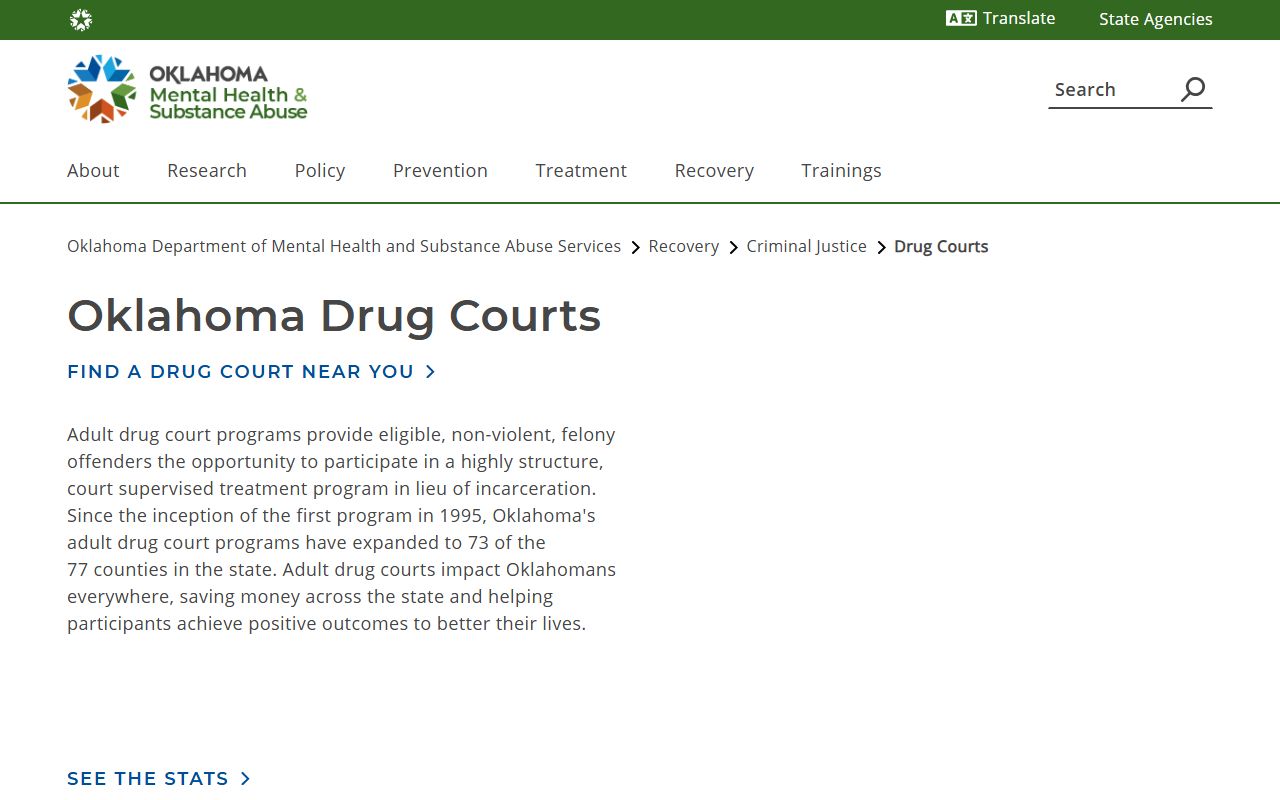
Whether an active drug court docket sits in Adair County is worth confirming before you count on it. Check current local availability with the Adair County District Court or the District 27 District Attorney, since the state program is statewide but local schedules can vary.
Sealed vs Expunged Adair County Records
People often use the words sealed and expunged as if they mean the same thing, but they do not. Both limit who can see a record. They differ in how far that limit goes and in what the law leaves behind. The table sets out the split.
| Point | Sealed | Expunged |
|---|---|---|
| Visibility | Hidden from public view | Treated as if it never existed |
| Law Enforcement | Limited access remains | Very limited access remains |
| What the Public Sees | Often no record, or only a stub | No record on the public portal |
| Eligibility | Set by 22 O.S. Sections 18 and 19 | Set by 22 O.S. Sections 18 and 19 |
Oklahoma's expungement law lives in two statute sections. The first sets who qualifies, and the second lays out the steps. You can read the text through the state court system itself. The 22 O.S. Section 18 page lists the categories of arrests, charges, and convictions that may be sealed.
Reading the eligibility list first saves a wasted filing. If the outcome qualifies, the next section of the law walks through the procedure. The steps below trace how an Adair County expungement moves through the court.
- Find the arrest or case number for the record you want to clear.
- Check whether the outcome qualifies under 22 O.S. Section 18.
- File a petition in the court where the case sat, which for Adair County cases is the Adair County Court Clerk.
- Give notice to the agencies and the district attorney named in the law.
- Attend any hearing the court sets on the petition.
- Obtain the signed order and serve it on the record repositories so they can update access.
The procedure section spells out the notice and hearing rules. The 22 O.S. Section 19 page covers who must be served and how the order takes effect.
Once the court grants the order, the public portals may show nothing or only limited data. Note: a sealed or expunged record can still reach law enforcement or come back by a later court order, even after it drops off the public docket.
Restricted Criminal Court Records in Adair County
Some criminal records never reach the public docket. The law shields them to protect children, victims, and sensitive data. A search that returns nothing is not always a portal error. It can mean the file is closed by statute or by court order. The categories below carry the tightest limits.
- Juvenile cases, which the Children and Juvenile Code keeps confidential and apart from adult dockets.
- Sealed and expunged records, where a judge has cut off public access under the expungement law.
- Mental health and competency matters, which involve medical and safety details.
- Sensitive identifiers, like Social Security numbers, account numbers, and protected addresses, which are redacted.
- Ongoing or under-seal filings that a court has not yet released.
Juvenile records carry their own rulebook. The Title 10A Children and Juvenile Code, at 10A O.S. Section 2-6-102, makes juvenile court records confidential, and Section 2-6-109 allows qualifying juvenile records to be expunged. Do not assume a juvenile matter shows up the way an adult case does. When a record you expect is missing or blocked, the Adair County Court Clerk can tell you whether it is sealed, restricted, or simply not yet online.